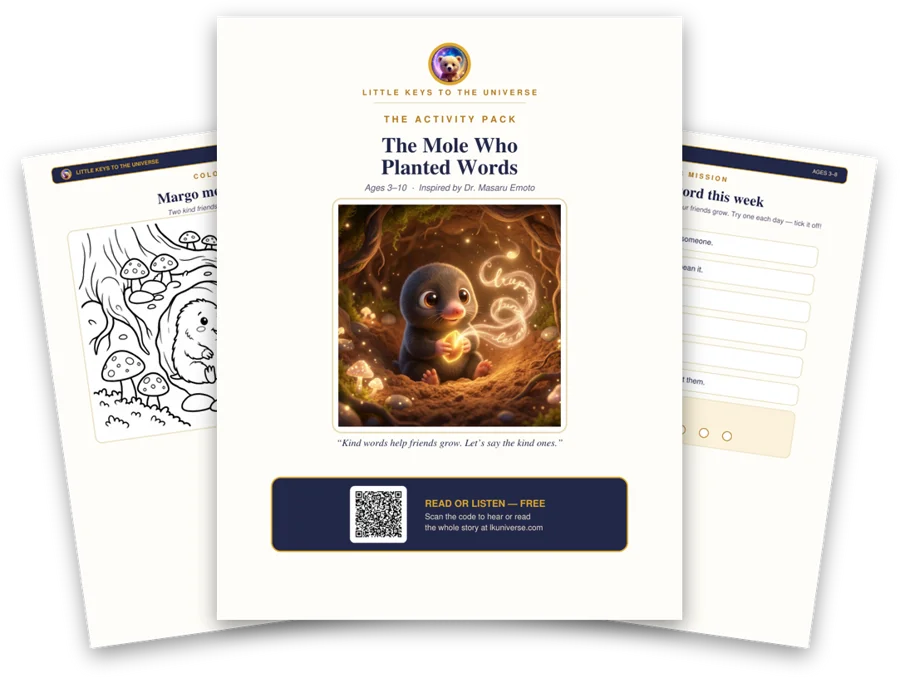

On a tranquil evening, as the stars shimmered in the night sky, a magical key appeared and unlocked a glowing door. Beyond the door lay a lush woodland garden, where towering sunflowers stretched toward the sky and tiny bluebells hummed softly in the breeze. A stream bubbled gently through the landscape, and the air carried the scent of blooming jasmine.
At the edge of the garden, beside a patch of tangled weeds, stood a small mole named Margo. Her tiny paws were dusty from digging, and her round nose twitched as she surveyed the mess of thorny vines and overgrown brambles before her. She sighed, shaking her head.
"I don’t understand," she murmured. "I plant seeds just like everyone else, but nothing beautiful ever grows for me. My garden always looks messy. Maybe I just can’t grow a garden like theirs."
From behind a sunflower, a wise old hedgehog named Thistle emerged. His quills shimmered in the moonlight, and his warm eyes twinkled as he waddled closer.
"Good evening, Margo," he said kindly. "What’s troubling you?"
Margo let out a frustrated sigh. "It’s my garden. I try so hard, but my plants are always small and weak. And now these weeds have taken over. I must be doing something wrong."
Thistle peered at the weeds, tapping his paw thoughtfully. "Hmm, I think I see the problem. Margo, do you know what kind of seeds you’ve been planting?"
Margo blinked. "Just the usual ones. I plant them, water them, and wait, but they never grow like I want them to."
Thistle chuckled softly. "Ah, but the seeds you plant are more important than you realize. You see, every word you speak is like a seed. When you say ‘I can’t,’ you plant weeds, and they grow quickly, choking out the flowers. But when you say ‘I can,’ you plant flower seeds, and those grow into something truly beautiful."
Margo frowned, looking at her overgrown garden. "That doesn't make sense. These weeds just appeared! I never planted them."
Thistle gave her a knowing look. "Think back, Margo. What do you say to yourself when your plants don’t grow right away?"
Margo hesitated. "Well… I guess I do say things like ‘I’ll never get it right’ or ‘I can’t grow anything pretty.’"
Thistle nodded. "And there it is. Your words have been planting weeds without you realizing it."
Margo huffed, crossing her arms. "So, what do I do? Just say ‘I can grow flowers,’ and suddenly my garden is perfect? That’s silly."
Thistle smiled. "Not suddenly. Just like a real garden, it takes time. But let’s try something."
He pointed to a particularly large thorny weed. "Pull that up, and as you do, say, ‘I can grow flowers.’"
Margo rolled her eyes but reached for the weed anyway. "I… I can grow flowers," she muttered, giving it a firm tug. But the weed didn’t budge. She pulled again—still stuck.
She groaned. "See? This doesn’t work!"
Thistle’s eyes twinkled with patience. "Weeds that have been growing a long time take more effort to remove. But that doesn’t mean they can’t be pulled. Try again, and really mean it."
Margo clenched her jaw, squared her shoulders, and took a deep breath. This time, she believed it.
"I can grow flowers."
As she pulled, the weed loosened easily, slipping free from the soil. The ground beneath it shimmered, and where the weed had been, a tiny sprout poked through.
Margo gasped. "Wait… that actually worked?"
"See?" Thistle smiled. "Now, let’s plant something new. Take this seed." He rolled a small, golden seed toward her. "Say, ‘I can grow something beautiful,’ and plant it in that open space."
Margo hesitated, then took the seed carefully in her paws. "I can grow something beautiful," she said, pressing it into the soil.
At once, the earth glowed softly, and a vibrant flower began to bloom, its petals catching the light like tiny golden suns.
Her eyes widened. "It really worked."
Thistle grinned. "Of course, it did. Your garden listens to your words, Margo. When you say ‘I can’t,’ the weeds take over. But when you say ‘I can,’ you make space for beauty to grow."
Margo turned back to her garden. There were still plenty of weeds, but for the first time, she didn’t feel discouraged. She grabbed another thorny vine.
"I can clear my garden."
She pulled—and the weed came loose.
"I can plant flowers." Another weed gone.
"I can make this a beautiful place." This time, three blossoms bloomed at once.
Margo worked until her patch of soil was transformed—bursting with radiant flowers, glowing vines, and delicate blossoms that swayed in the breeze.
She turned to Thistle, beaming. "Thank you. I never realized how much my words mattered."
Thistle’s eyes twinkled. "Words are magic seeds, Margo. They shape what grows in our lives. Choose them wisely, and you’ll always have a beautiful garden."
"And so, Margo discovered that her words were not just sounds but seeds, shaping the world around her. The key she found unlocked a truth we all share—what we plant with our words, we grow in our lives.