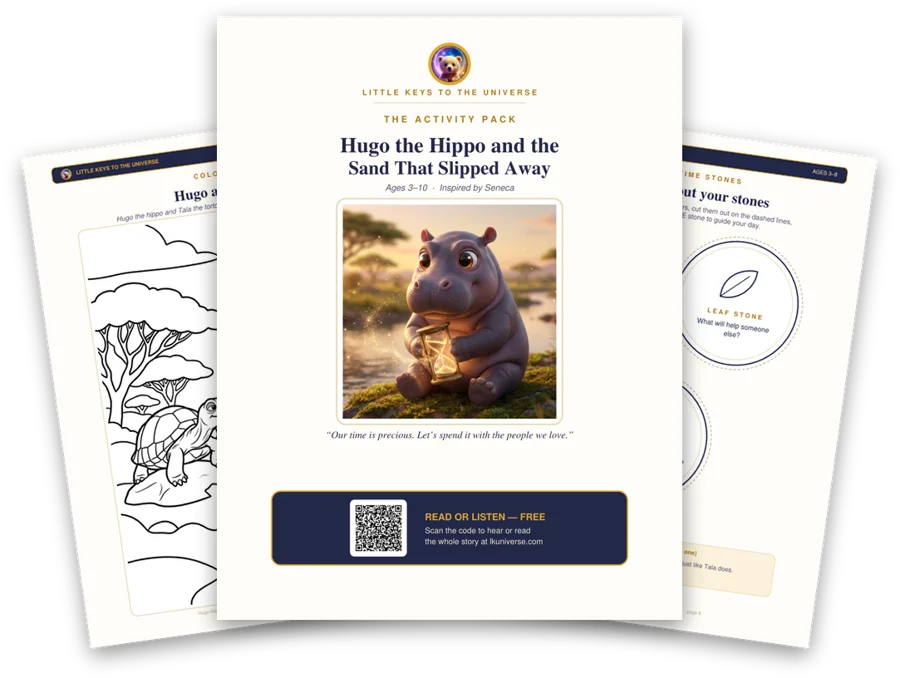

This story is inspired by Seneca, a wise philosopher who said, “It is not that we have a short time to live, but that we waste much of it.” You see, time is one of the most precious things we’ll ever have—but it doesn’t come with a map. When we’re young, it can feel like time will last forever. But if we say yes to everything and forget to choose what really matters, time can slip away like sand through our paws.
Let’s travel into the jungle now, where one very busy hippo is about to learn that a little focus can change everything.
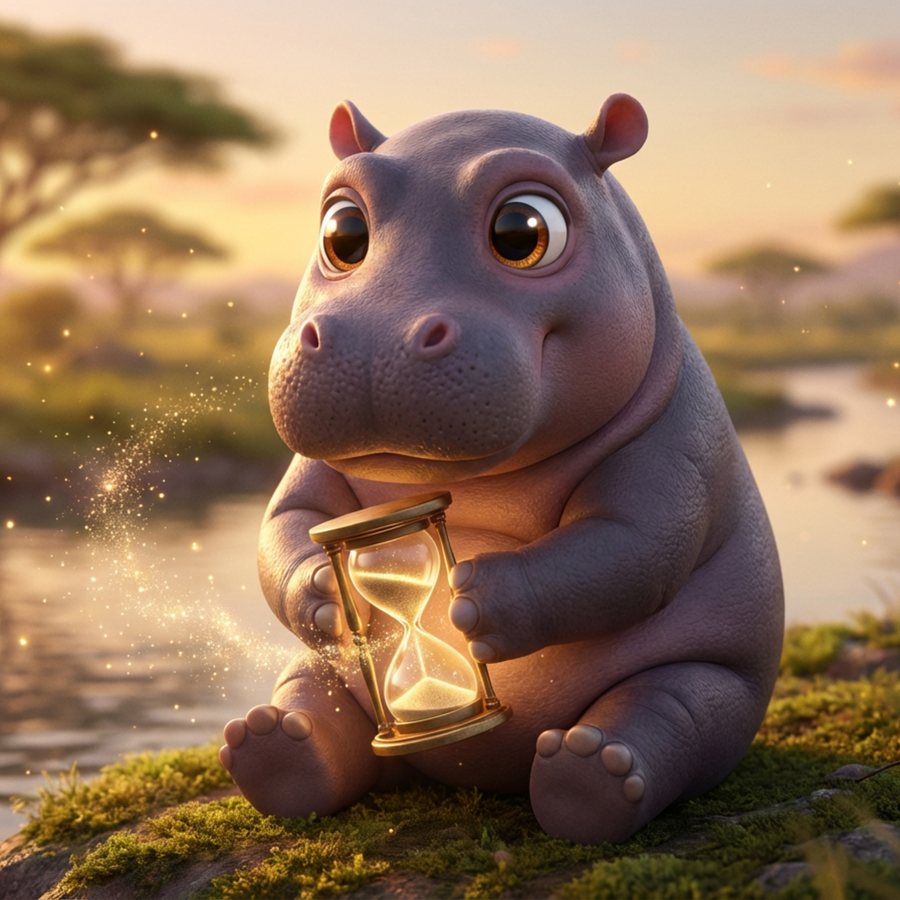
In the middle of a bright, buzzing jungle lived a young hippo named Hugo. Hugo had a big heart—and even bigger plans. Every day, he said yes to everything: climbing Coconut Hill, helping carry mango crates, watching eggs, jumping in every river race, joining every game.
But somehow, every night, Hugo felt... empty.
His art supplies sat untouched. His journal lay blank. He never stargazed anymore. The quiet things—the ones that made him feel most like himself—never seemed to fit into the day.
One morning, worn out and heavy with frustration, Hugo wandered deeper into the jungle than ever before. He stumbled into a quiet grove, where the air felt still and golden.
In the center stood a sand timer, taller than any tree. Its grains of sand fell slowly, with a soft, musical hush, like rain on a drum.
An old tortoise named Tala was sweeping leaves nearby.
"Lost your time again, have you?" she said with a small smile.
Hugo blinked. "How did you know?"
Tala pointed to his muddy feet and tangled thoughts. "Time leaves clues. You just stopped listening."
She reached into a pouch and held out three small stones, each engraved with a different symbol: a heart, a leaf, and a mirror.
"These are the Three Questions of Time," she said. "Each morning, choose one. Let it guide your day."
Hugo turned the stones in his paw. They felt warm and a little mysterious.
That night, he thought about the first question: What will fill my heart?
The next morning, Hugo looked around his home. His eyes landed on a dusty set of paints buried under old chores and to-do lists. Slowly, he opened them. Then he began to paint—sweeping jungle vines, star-speckled skies, a sleepy moon. As color filled the page, something inside him brightened too.
But just as he found his rhythm, Millie the Monkey swung by.
"Hey! Want to help build a banana bridge?"
Hugo paused. "I'm painting right now..."
"Oh come on, you always help."
He almost stood up. Almost said yes. But then he remembered the question—and how calm his heart had felt.
"I'll help later," Hugo said gently. "After I finish this."
Millie blinked in surprise, then swung away.
For the first time in a long time, Hugo finished something just for himself. And it made his heart hum like a quiet song.
The next day, he chose the second stone. What will help someone else?
He soon spotted Ollie the Ostrich struggling with a pile of firewood. Hugo smiled and lent a paw. They worked side by side, humming and stacking until the pile was steady.
But after that, he kept going. He cleaned Bella’s nest, fixed Lenny’s ladder, and carried baskets for the ant parade. By the time the sun set, his legs ached and his head drooped.
He found his way back to the sand grove and collapsed onto the moss.
"I tried to help," he said to Tala, "but I did too much. Again."
Tala nodded. "Helping others doesn't mean helping everyone at once. A single act, done with care, is more than enough."
The next morning, Hugo helped just one friend. Fully. Kindly. Then he rested. It felt unfamiliar—but also lighter. Like he'd made space for his own breath.
On the third day, Hugo picked up the final stone. The mirror.
What must I face in myself?
He stared into the stream and felt his shoulders slump.
"I’m scared people won’t like me if I say no,” he whispered. “I don’t want to disappoint anyone.”
The mirror shimmered in the sunlight. And in the stillness, he remembered something Tala had said:
Peace isn’t found in pleasing everyone. It’s found in being true to your time.
So that day, Hugo practiced.
“No, I can’t join today. I need some quiet.”
“No, not right now. I’m choosing rest.”
Some animals looked confused. A few seemed annoyed.
But then something surprising happened.
Later, Bella whispered, “I think I need quiet time too.”
And Ollie asked, “How did you know what to choose?”
Hugo didn’t have a big answer. Just a small one.
“I started listening,” he said.
Days passed.
Hugo still helped. Still played. Still painted.
But not everything. And not all at once.
Each day, he chose one thing that made his heart feel full, one act of kindness for someone else, and one small truth to face in himself.
The jungle still spun and swayed with noise and color. But Hugo didn’t feel lost in it anymore.
He walked beside time, like someone who knew it was a gift.
And so, Hugo the Hippo discovered that managing time isn’t about doing more. It’s about doing what matters.
As Seneca said, “Life is long, if you know how to use it.”
So tonight, before your eyes grow heavy, ask yourself:
What will fill my heart?
What will help someone else?
And what do I need to face in myself?
Then listen gently for your answer, like the soft fall of sand in a timer.