A kind teacher named Dr. Marc Brackett helps children and grown-ups understand their feelings.
He says that every feeling matters—even the hard ones.
Because when we understand what we feel, we can start to feel better.
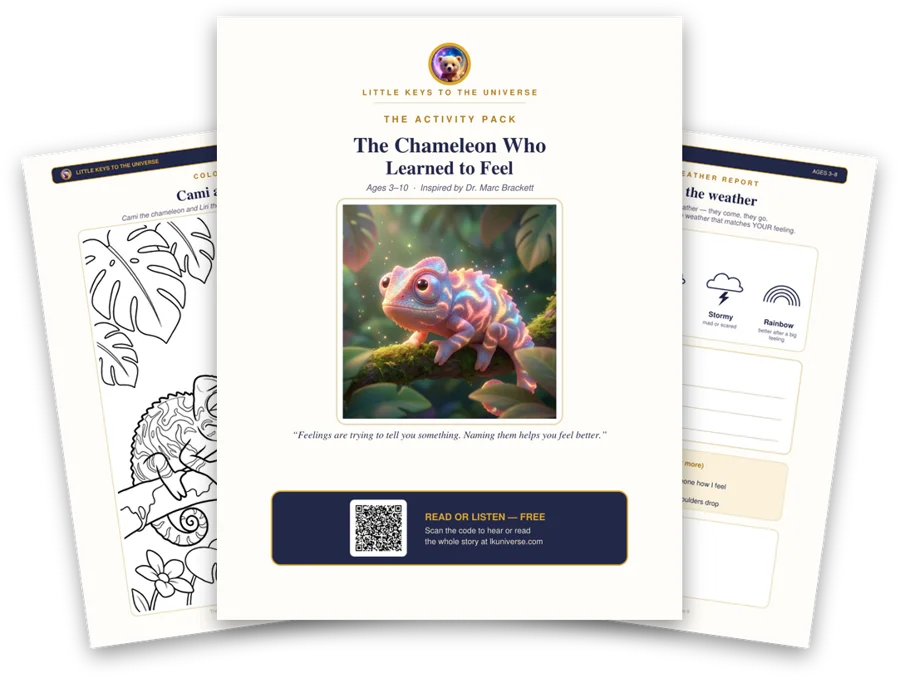
In tonight’s story, you’ll meet Cami the chameleon—a little lizard who changes colors to match anything.
But when her feelings get big, she hides them instead.
Until one gentle butterfly helps her learn that feelings aren’t scary…
they’re just messages trying to be heard.
Let’s turn the key…
and step inside.
Cami lived in a bright, leafy forest, where the flowers glowed and the trees reached for the clouds.
She was very good at hiding.
Cami could turn bark-brown, leaf-green, flower-pink—whatever she needed to blend in.
And that’s just what she did…
every time she felt a feeling.
When she felt sad, she turned bark-brown and sat still on a log.
When she felt angry, she turned spiky green and hid behind a bush.
When she felt scared, she turned sky-blue and looked at the clouds.
No one ever saw her cry.
No one ever heard her say “ouch” or “stop” or “I don’t like that.”
She just… disappeared.
“If I don’t show my feelings,” she told herself,
“maybe they’ll go away.”
But they didn’t.
Something was building inside—
like thunder in her chest
and clouds behind her eyes.
A storm she couldn’t explain.
One day, while sitting as still as a stick, Cami heard a flutter.
A small, soft voice said,
“Why are you hiding your sunshine?”
Cami blinked.
Floating nearby was a bright blue butterfly.
“I’m not hiding,” Cami said quickly. “I’m just… matching the tree.”
The butterfly tilted her head.
“I’m Liri,” she said. “And I saw you change colors when you got sad. Then angry. Then scared.
That’s not tree-matching, that’s feeling-hiding.”
Cami didn’t know what to say.
“It’s just easier,” she mumbled. “If I show how I feel… I might cry. Or shout. Or look silly.”
Liri landed gently beside her.
“That’s okay,” she whispered. “Feelings are like the weather. They come, they go.
But when you hold them inside…”
She flapped her wings.
“...they build up into a storm.”
Cami looked down at her feet.
“I think… I have a storm inside.”
Liri smiled.
“Then maybe it’s time to let it rain.”
Cami took a deep breath.
She let her tail uncurl.
She let her shoulders drop.
She let her colors shift to a soft stormy purple.
And then…
a single tear rolled down her cheek.
“I feel sad,” she whispered. “And a little mad. And also tired.”
Liri nodded.
“That’s brave, Cami.”
The wind rustled gently through the trees.
Cami felt her body loosen, like a puddle after the rain.
Her colors shimmered—blues, pinks, even a little golden yellow.
For the first time in a long time, she didn’t feel like hiding.
She felt like… her.
After that, Cami didn’t try to match the tree all the time.
Sometimes she was raincloud-gray.
Sometimes she was sunflower-yellow.
Sometimes she was a hundred colors all at once.
And when someone asked how she was feeling,
She’d pause, look inside, and say:
“Let me check the weather.”
Dr. Marc Brackett teaches that feelings are not bad or wrong.
They’re messages—like a friend tapping your shoulder to say, “Hey, something’s going on.”
When we name our feelings, we can understand them.
And when we let them move through us, they pass like a storm…
and leave space for sunshine.
So next time you feel something big—
instead of hiding it…
Let it rain.
Let it shine.
Let it be felt.
Because you are safe to feel it all.