From the moment we are small, we begin forming habits of thought—whether we stay curious or avoid the unknown, try new things or stick to what we already know.
Dr. Carol Dweck, a wise teacher, reminds us that the way we think shapes the way we grow. When we keep an open mind, we learn and discover new things about the world—and about ourselves.
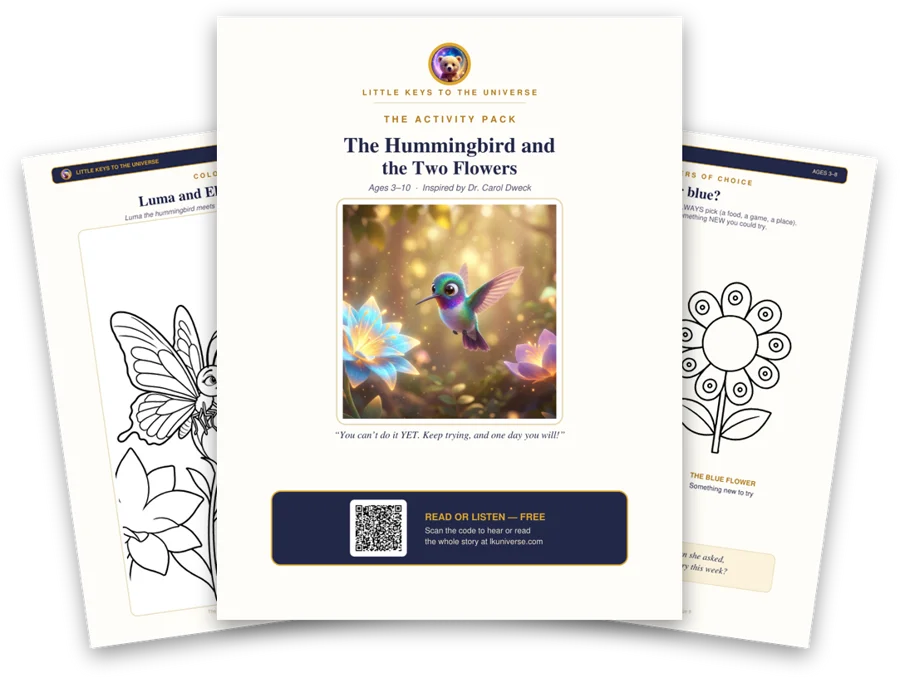
Let’s follow the flight of Luma, a young hummingbird who thought she already knew what she liked… until a single flower changed everything.
The sun warmed the fields of Meadowcrest, where Luma the hummingbird zipped from bloom to bloom.
She knew this meadow well. She had her favorite flowers, her favorite spots, her favorite paths through the breeze. Everything felt just right.
But one thing Luma didn’t like?
New flowers.
One morning, as she hovered near a familiar pink lily, a breeze carried a scent she didn’t recognize—rich, honeyed, and a little strange.
Luma wrinkled her beak. “That smells weird.”
She turned away. There were plenty of other flowers to choose from. Why take a chance on something unfamiliar?
Later that morning, Luma spotted a group of hummingbirds gathered near the garden’s edge. In the center sat Elder Mariposa, a wise butterfly with wings like golden silk.
“Luma,” Mariposa called. “Come join us. We’re talking about the Two Flowers of Choice.”
Luma landed nearby. “The what?”
Mariposa fluttered toward two flowers that stood side by side—one soft pink and familiar, the other deep blue with swirling petals like the night sky.
“One flower represents a closed mind,” said Mariposa. “It’s safe, predictable, and comfortable. The other represents an open mind. It’s full of surprise, learning, and the unknown.”
Luma folded her wings. “I don’t need new flowers. I already know what I like.”
“Do you?” Mariposa asked with a smile.
Luma huffed. “What if it’s bitter? What if I hate it?”
Mariposa’s eyes twinkled. “What if you love it?”
The others cheered. “Come on, Luma! Try it!”
Luma looked at the deep blue flower. She took a small step forward… but then pulled back.
“No thanks,” she said. “I already know I won’t like it.”
The others sighed.
Mariposa didn’t push. “Just remember,” she said gently, “if we never try, we may never grow.”
Days passed.
Luma returned to her usual flowers. But something was different.
The nectar didn’t taste as sweet. Her wings felt slower. She grew restless, like something inside her wanted more.
She watched the others zip across the sky, laughing, dancing, full of energy.
“What’s gotten into all of you?” she asked.
One of her friends giggled. “We tried the blue flower. It’s amazing!”
Luma frowned. Could one flower really make that much of a difference?
She returned to her favorite pink lily and drank deeply. But when she lifted her head, she felt… the same.
Tired. Slow. Stuck.
She looked toward the blue flower, still waiting.
Her feathers twitched. Her heart beat faster.
What if it really was awful?
But then a quieter thought rose beneath the fear:
What if I love it?
Mariposa met her eyes from across the garden. She gave a slow, knowing nod.
Luma took a deep breath. Then—she drank.
And the moment the nectar touched her tongue, her eyes widened.
It wasn’t just good. It was alive.
Sweet, bright, warm. It filled her wings with wind, her heart with light.
She zipped through the sky like she had never flown before.
“Whoa!” she laughed.
The others cheered. Mariposa clapped her wings.
“Now you know,” she said. “The world is full of things we haven’t tried yet. Growth lives on the other side of ‘what if.’”
Luma hovered in place, her mind buzzing—not with fear, but with wonder.
What else had she been missing?
And so, from that day forward, Luma stopped saying, “I already know.” She started saying, “What if I love it?”
Every time she saw something new, she leaned in instead of pulling away.
Because trying didn’t make her smaller. It made her stronger.