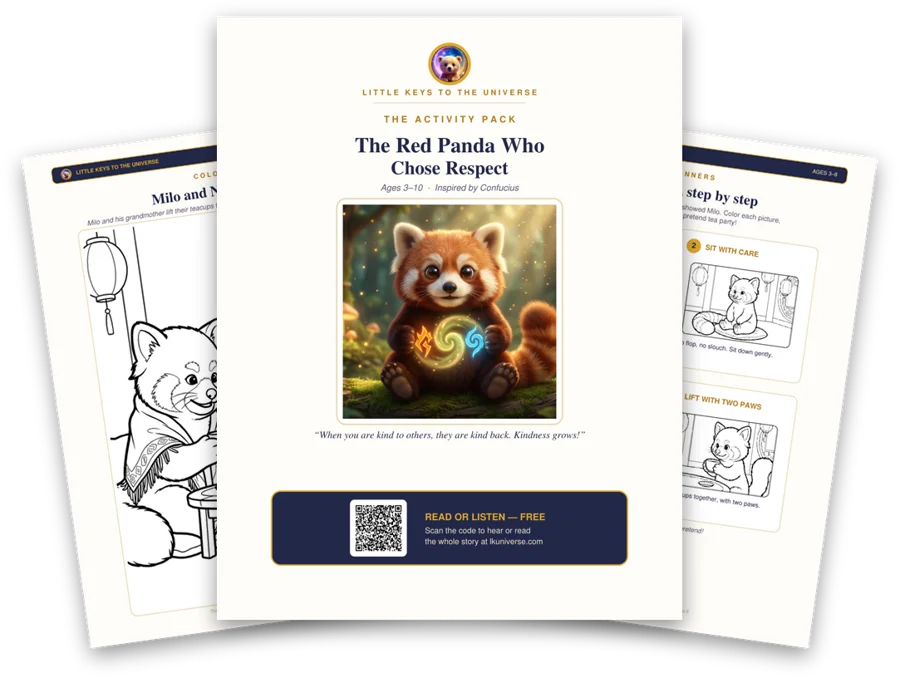
This story is inspired by Confucius, a wise teacher who showed us that true peace begins with how we treat one another. He believed that when we lead with respect and care, we help create a more harmonious world.
Let’s enter now, where a curious young red panda is about to learn that even a simple cup of tea can hold a powerful lesson.
In a quiet village where plum blossoms bloomed and paper lanterns swayed gently in the breeze, lived a young red panda named Milo.
Milo was clever, kind, and full of questions. But lately, something had been bothering him.
The village market had grown noisy and pushy. Everyone seemed in a hurry. Animals shouted over each other, bumped past without saying excuse me, and often forgot to say please or thank you. Even at home, Milo’s siblings grabbed things without asking or spoke over one another at the dinner table.
It made Milo’s fur bristle.
“Why is everyone being so rude lately?” he sighed one morning, his tail curling tightly around his feet.
His grandmother, Bao Nǎinai, looked up from the scroll she had been reading. She was known across the village for her peaceful tea ceremonies and her gentle way of living.
“Would you like to join me for tea this afternoon, Milo?” she asked with a twinkle in her eye.
Milo shrugged. “I guess. But tea won’t fix how messy and loud everyone is.”
Bao Nǎinai only smiled.
That afternoon, Milo arrived at her garden. Tiny wind chimes sang in the breeze, and a koi pond shimmered nearby. A small table was set with a teapot, two cups, and a round silk mat.
“Before we begin,” Nǎinai said, “there is a way we prepare for tea.”
She bowed low. Milo blinked. No one bowed anymore. Still, he copied her.
Next, she invited him to sit—not with a flop or a slouch, but with care, as if honoring the space they shared.
They listened to the bubbling of the kettle and the rustling of leaves overhead. No rushing. No talking over each other.
Then she poured the tea, slowly and steadily. When Milo reached for his cup, Nǎinai gently placed her paw on his.
“We wait for both cups to be filled,” she said, “and lift them together—with two paws—to show gratitude.”
Milo followed her lead.
And something shifted.
The warmth of the cup in his paws. The quiet between sips. The way each movement felt calm and thoughtful—it all felt… different.
“Why does this feel so peaceful?” Milo asked softly.
Nǎinai smiled. “Because manners are more than rules. They are a way of saying: I see you. You matter.”
Milo looked down at the swirling tea in his cup. “But out in the village… everyone forgets.”
“Then perhaps,” she said, “you can be the one who remembers.”
That evening, at dinner, Milo tried something new. He waited for everyone to sit before picking up his bowl. He passed the rice with both paws. He said, “Please.”
His little sister blinked. “Who are you?”
Milo smiled. “Someone who’s learning the magic of manners.”
The next day at the market, he let an elder go ahead of him in line. He smiled at a vendor and said, “Thank you.” He listened patiently when someone was speaking.
He didn’t make a big fuss about it.
But others noticed.
They softened. They slowed down.
And little by little, like tea filling a cup, something gentle began to return to the village: harmony.
And so, Milo the red panda discovered that manners are not just about politeness. They are small signs of respect—tiny reminders that we are all sharing the same space, and every action can be a choice for peace.
Just like Confucius once said, “Respect yourself, and others will respect you.” When we lead with care, we inspire others to do the same.
So tonight, as you drift off to sleep, remember: a single “please,” a gentle “thank you,” or a moment of stillness can be the first sip of a beautiful cup of harmony.