A long time ago, a man named Henry Ford said something very important:
"Whether you think you can, or you think you can't – you're right."
That means the words you say to yourself—whether they are full of doubt or full of courage—can shape what you are able to do.
Have you ever told yourself, “I can’t do it” before even trying? Maybe climbing the monkey bars felt too hard, or reading a big book seemed impossible. But what if, instead of saying “I can’t,” you said “I can try”?
When you believe you can, something magical happens—your brain and body work together to help you succeed!
Tonight, as the great stone gate creaks open, we step into the world of dinosaurs, where one small T-Rex is about to discover the power of belief.
As the stars twinkle above and the ancient world rumbles with life, let’s begin.
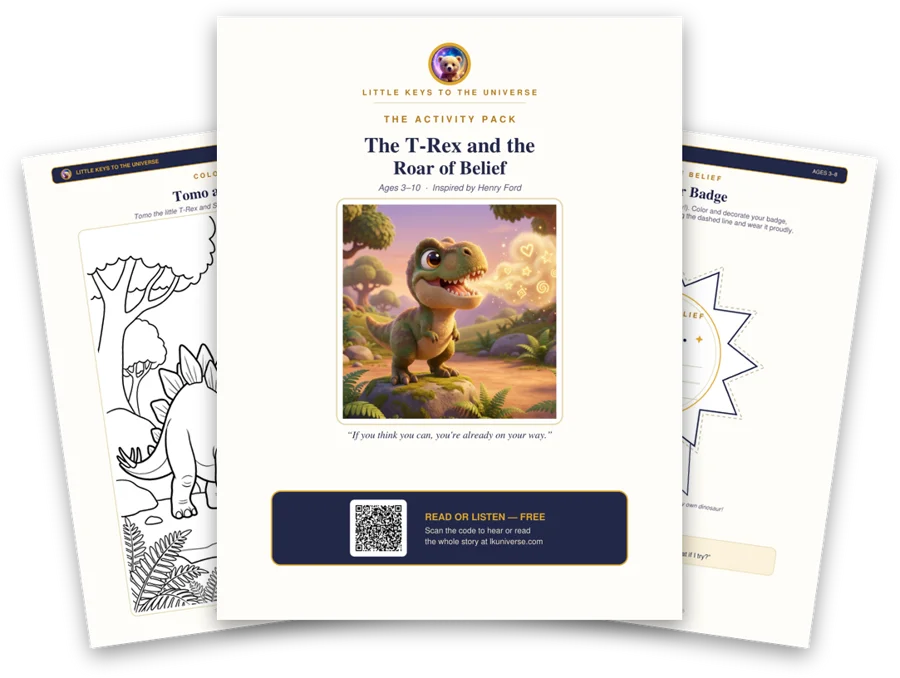
Deep in the heart of The Great Valley, where volcanoes rumbled and ancient rivers carved paths through the land, lived a young T-Rex named Tomo.
But unlike the other T-Rexes, Tomo was small. His legs weren’t as strong, his roar wasn’t very loud, and every time he tried to run, he tripped over his own feet.
And so, Tomo had learned to say three words:
“I can’t do it.”
He said it when the other young dinosaurs raced across the fields.
He said it when they played games that required climbing or jumping.
And he definitely said it when they practiced roaring.
“A T-Rex that can’t roar?” one of the bigger dinosaurs, Rudo, laughed. “You’ll never be like the great T-Rexes of the past!”
Tomo’s face burned with embarrassment. Maybe Rudo was right. Maybe he would never be as strong as the others.
And so, Tomo stayed behind. He watched. He waited. But he never tried.
One day, something terrible happened. A rockslide tumbled down from the cliffs of Shadow Valley, blocking the way back home.
Tomo’s friends were trapped on the other side. They needed help—fast!
“The only way to call for help is from Roaring Rock,” said Sage, a wise old Stegosaurus. She pointed her spiky tail toward the tallest peak in the valley. “Someone must climb it and let out a roar loud enough for the others to hear.”
The dinosaurs turned to Rudo. He was the biggest, the strongest… but his leg was injured from the rockslide. He couldn’t climb.
A silence fell over the group. Who would go?
All eyes turned to Tomo.
Tomo froze. “Me?” he squeaked. “I can’t do that!”
The words slipped out before he even thought about them.
“I can’t climb that high.”
“I can’t roar that loud.”
“I can’t be the one to save us.”
The whispers of Shadow Valley surrounded him:
"You’re too small."
"You’re not strong enough."
"You’ll never be great."
Sage stepped forward. “Tomo, do you know why Roaring Rock is special?”
Tomo shook his head.
“Because every dinosaur who has ever climbed it thought they couldn’t—until they tried.”
Tomo hesitated. “But… what if I fail?”
Sage smiled. “And what if you don’t?”
Tomo looked up at the towering rock. His heart pounded. The old voice in his head whispered, “I can’t.”
But then, a new thought appeared.
"What if I try?"
Tomo took a deep breath. He placed one claw on the first rock… and climbed.
At first, his legs wobbled. His tail swung side to side. The climb was hard, and for a moment, he thought about giving up.
But then, he remembered Sage’s words.
Every dinosaur who had ever climbed Roaring Rock had once thought they couldn’t.
And so, he kept going.
Higher.
Stronger.
Faster.
His muscles ached, but he didn’t stop.
His heart pounded, but he didn’t stop.
Until at last… he reached the top.
Tomo’s chest heaved. He could see the entire valley below. His friends, waiting. The Shadow Valley, whispering.
And then, he did something he had never done before.
He roared.
At first, it was small—shaky, like a whisper of wind.
But then… it grew.
Louder.
Stronger.
Powerful.
The sound echoed across the valley, bouncing off cliffs and trees.
It was his voice.
And for the first time, he believed in it.
The other dinosaurs heard it.
And then—from across the valley—roars answered back.
Help was coming.
Tomo had done it.
Not because he was the biggest.
Not because he was the strongest.
But because he had tried.
From that day forward, Tomo never said "I can't" again.
He still faced challenges—there were still high cliffs, tricky paths, and new things to learn.
But now, instead of stopping himself, he asked, "What if I try?"
Because he had learned the most important lesson of all:
"Whether you think you can, or you think you can't—you’re right."
And guess what?
You can do the same.
Tonight, before you close your eyes, try this:
Think of something you really want. Not as a wish, but as if it’s already real.
Feel it deep inside—what would it be like if it were already true?
Imagine waking up tomorrow and seeing it in your world.
Hold onto that feeling as you drift into sleep.
Your thoughts are like ripples in the water—what you believe about yourself shapes what you can do.
This is one of the most powerful things you can learn while you’re still young.
The world around you isn’t just happening—you are creating it.
So… what kind of world will you wake up to tomorrow?
That’s up to you.
Sweet dreams.